

Altium MCP Server
TLDR: Use Claude to control or ask questions about your Altium project. This is a Model Context Protocol (MCP) server that provides an interface to interact with Altium Designer through Python. The server allows for querying and manipulation of PCB designs programmatically.
Note: Having Claude place components on the PCB currently fails hard.
Example commands
- Run all output jobs
- Create a symbol for the part in the attached datasheet and use the currently open symbol as a reference example.
- Create a schematic symbol from the attached MPM3650 switching regulator datasheet and make sure to strictly follow the symbol placement rules. (Note: Need to open a schematic library. Uses
AppData\\Roaming\\Claude\\Claude Extensions\\local.dxt.altium-mcp\\server\\symbol_placement_rules.txtdescription as pin placement rules. Please modify for your own preferences.) - Find me the LM358 symbol in my opamp library and open it
- Create a multi-part symbol for a quad op-amp from the attached LM324 datasheet (creates parts A, B, C, D with shared V+/V- power pins)
- Create a PCB footprint for the SMD part in the attached datasheet and add it to my open PcbLib
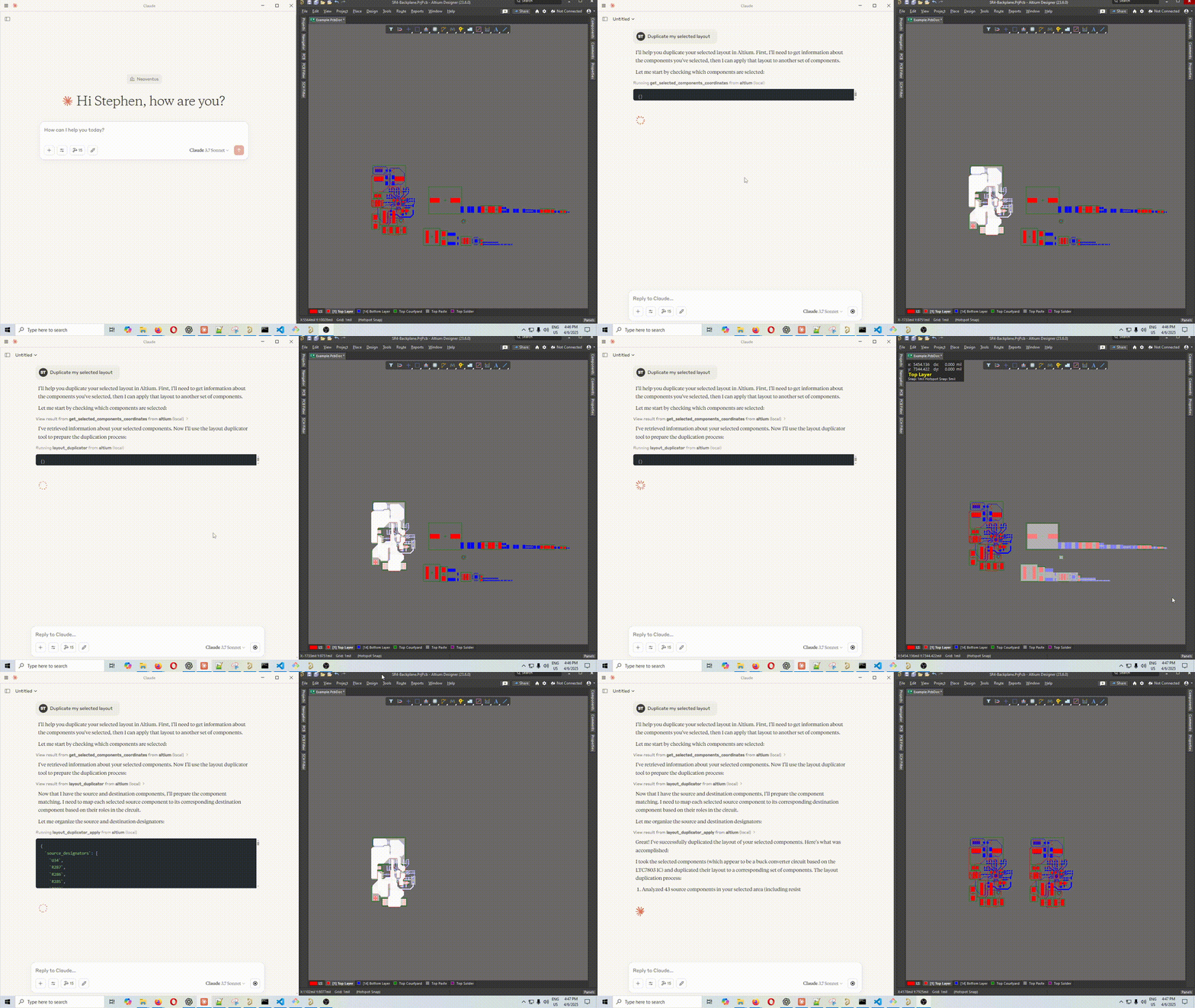
- Duplicate my selected layout. (Will prompt user to now select destination components. Supports Component, Track, Arc, Via, Polygon, & Region)
- Show all my inner layers. Show the top and bottom layer. Turn off solder paste.
- Get me all parts on my design made by Molex
- Give me the description and part number of U4
- Place the selected parts on my pcb with best practices for a switching regulator. Note: It tries, but does terrible placement. Hopefully I can find a way to improve this.
- Give me a list of all IC designators in my design
- Get me all length matching rules
Installing the MCP Server
The easiest way to install is to use Claude Code, point it to this repo and ask it to install it for you. Or alternatively, see below.
- Make sure Claude has Python 3.10+ installed:
drop down > File > Settings > Extensions > Advanced > Python. If not, install Python and add it to PATH. - Download the
altium-mcp.dxtdesktop extension file from releases - In Claude Desktop on Windows:
drop down > File > Settings > Extensions > Advanced > Install Extension...Select the .dxt file
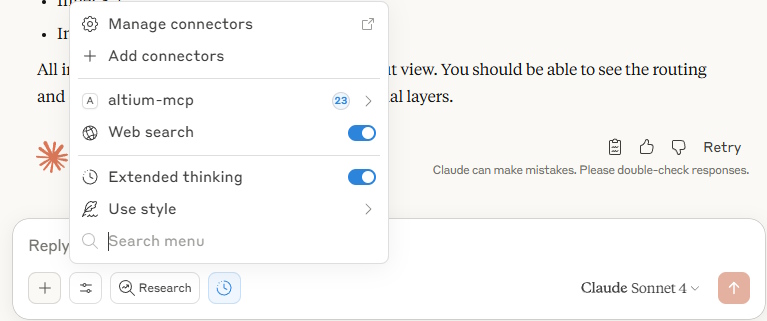
You shouldn't need to restart Claude and you should now see altium-mcp in the tool menu near the search bar.
Creating a new .dxt (For Developers)
Bootstrap Venv (Recommended)
This approach ships a small bootstrap script (start_server.py) that creates a virtual environment and pip-installs dependencies on the user's machine at first launch. The .dxt is tiny (~60 KB) and works across any Python 3.10+ version.
The older approach of bundling pre-compiled packages in server/lib/ is no longer recommended — it breaks when the user's Python version doesn't match the version used to build the bundled .pyd files (e.g. pydantic_core compiled for 3.11 fails on 3.13).
How it works:
start_server.py(at the repo root) checks forserver/.venv/Scripts/python.exe- If the venv doesn't exist, it creates one and pip-installs the pinned dependencies
- It then launches
server/main.pyusing the venv's Python - First launch takes ~20-30 seconds; subsequent launches are instant
Build steps:
- Make sure
start_server.pyexists at the repo root (see below for contents) - Make sure
server/main.pydoes NOT have the oldsite.addsitedirhack at the top - Update
manifest.json: setentry_pointtostart_server.py, remove anyenv/PYTHONPATHfields, and usemanifest_version: "0.3" - Package the DXT — either use
dxt packor manually zip and rename:
Compress-Archive -Path manifest.json, start_server.py, pyproject.toml, server -DestinationPath altium-mcp.zip
Rename-Item altium-mcp.zip altium-mcp.dxt
Do NOT include server/lib/ or server/.venv/ in the .dxt. The whole point is that these are created on the user's machine.
start_server.py:
import subprocess
import sys
from pathlib import Path

SCRIPT_DIR = Path(__file__).parent
VENV_DIR = SCRIPT_DIR / "server" / ".venv"
REQUIREMENTS = [
    "mcp[cli]==1.5.0",
    "pillow>=11.1.0",
    "pywin32>=310",
]

def ensure_venv():
    python_exe = VENV_DIR / "Scripts" / "python.exe"
    if python_exe.exists():
        return str(python_exe)

    subprocess.check_call([sys.executable, "-m", "venv", str(VENV_DIR)])
    pip_exe = str(VENV_DIR / "Scripts" / "pip.exe")
    subprocess.check_call([pip_exe, "install", "--quiet"] + REQUIREMENTS)
    return str(python_exe)

if __name__ == "__main__":
    venv_python = ensure_venv()
    server_path = str(SCRIPT_DIR / "server" / "main.py")
    sys.exit(subprocess.call([venv_python, server_path]))
manifest.json server section:
"server": {
    "type": "python",
    "entry_point": "start_server.py",
    "mcp_config": {
      "command": "python",
      "args": ["${__dirname}/start_server.py"]
    }
  }
Pitfalls
These are hard-won lessons from debugging DXT builds. Violating any of these will produce errors that are difficult to diagnose.
-
Do NOT use
os.execv()instart_server.py. The DXT installs to a path containing spaces (Claude Extensions). On Windows,os.execvsplits the path at the space and fails. Usesys.exit(subprocess.call([...]))instead. -
Pin
mcpto==1.5.0. Using>=1.5.0pulls in the latest version, which has breaking API changes (FastMCP.__init__()dropped thedescriptionkwarg). The server code was written against 1.5.0. -
Do NOT use
manifest_version: "0.4"with"type": "uv". Claude Desktop does not support it yet. You will getInvalid manifest: server: Required. Use"type": "python"withmanifest_version: "0.3". -
After removing the
site.addsitedirhack frommain.py, fix thepathlib.Pathreference. The hack includedimport pathlibat the top of the file. The logging setup later usespathlib.Path(...)which will throwNameErroronce that import is gone. Change it toPath(...)— thefrom pathlib import Pathimport already exists in the file, just make sure it comes before the logging setup. -
Do NOT bundle
server/lib/in the DXT. That was the old approach and defeats the purpose of the venv bootstrap.
Legacy: Bundled server/lib (Not Recommended)
This approach bundles all dependencies in server/lib/ and sets PYTHONPATH to point to it. It produces a much larger .dxt (~17 MB) and only works if the user's Python version matches the version used to compile the bundled packages.
- Populate packages:
python -m pip install --no-cache-dir --target server/lib -r requirements.txt - Set the manifest
entry_pointtoserver/main.pyand add"env": {"PYTHONPATH": "${__dirname}/server/lib"}tomcp_config - Package:
npm install -g @anthropic-ai/dxt && dxt pack
DXT Resources
- Desktop Extensions
- Desktop Extensions Github
- Getting Started with DXT
- Python DXT Example Code
- DXT Manifest
Configuration
When launching claude for the first time, the server will automatically try to locate your Altium Designer installation. It will search for all directories that start with C:\\Program Files\\Altium\\AD* and use the one with the largest revision number. If it cannot find any, you will be prompted to select the Altium executable (X2.EXE) manually when you first run the server. Altium's DelphiScript scripting is used to create an API between the mcp server and Altium.
Available Tools
The server provides several tools to interact with Altium Designer:
Output Jobs
get_output_job_containers: Using currently open .OutJob file, reads all available output containersrun_output_jobs: Pass a list of output job container names from the currently open .OutJob to run any number of them..OutJobmust be the currently focused document.
Component Information
get_all_designators: Get a list of all component designators in the current boardget_all_component_property_names: Get a list of all available component property namesget_component_property_values: Get the values of a specific property for all componentsget_component_data: Get detailed data for specific components by designatorget_component_pins: Get pin information for specified components
Schematic/Symbol
get_schematic_data: Get schematic data for specified componentscreate_schematic_symbol(YouTube): Passes pin list with pin type & coordinates to Altium script. Supports multi-part symbols (e.g. quad op-amps) via apart_countparameter and anowner_part_idfield on each pin (use 0 for shared power/GND pins). Also supports active-low pin name overbars by placing a backslash after each overbarred character (e.g.R\\E\\S\\E\\T\\renders asRESETwith overbar).get_symbol_placement_rules: Create symbol's helper tool that reads~\\AppData\\Roaming\\Claude\\Claude Extensions\\local.dxt.altium-mcp\\server\\symbol_placement_rules.txtto get pin placement rules for symbol creation.get_library_symbol_reference: Create symbol's helper tool to use an open library symbol as an example to create the symbolsearch_library_symbol: Search for a symbol by name in a schematic library (.SchLib) and navigate to it. Supports partial name matching. Will open the library file in Altium if a path is provided, or show a file picker if not.

Layout Operations
get_all_nets: Returns a list of unique nets from the pcbcreate_net_class(YouTube): Create a net class from a list of netsget_pcb_layers: Get detailed layer information including electrical, mechanical, layer pairs, etc.get_pcb_layer_stackup: Gets stackup info like dielectric, layer thickness, etc.set_pcb_layer_visibility(YouTube): Turn on or off any group of layers. For example turn on inner layers. Turn off silk.get_pcb_rules: Gets the rule descriptions for all pcb rules in layout.get_selected_components_coordinates: Get position and rotation information for currently selected componentsmove_components: Move specified components by X and Y offsetslayout_duplicator(YouTube): Starts layout duplication assuming you have already selected the source components on the PCB.layout_duplicator_apply: Action #2 oflayout_duplicator. Agent will use part info automatically to predict the match between source and destination components, then will send those matches to the place script.
The cool thing about layout duplication this way as opposed to with Altium's built in layout replication, is that the exact components don't have to match because the LLM can look through the descriptions and understand which components match and which don't have a match. That's something that can't really be hard coded.
PCB Footprint Library
create_pcb_footprint: Create a new PCB footprint in the currently active .PcbLib document. Supports SMD pads (Rect, Round, Oval shapes) defined in mm relative to the component origin. Auto-generates a courtyard on Mech 15 and silkscreen with a pin 1 indicator (gap in the top-left corner), or accepts explicit courtyard dimensions. Contributed by coffeedust (PR #7).
Both
get_screenshot: Take a screenshot of the Altium PCB window or Schematic Window that is the current view. It should auto focus either of these if it is open but a different document type is focused. Note: Claude is not very good at analyzing images like circuits or layout screenshots. ChatGPT is very good at it, but they haven't released MCP yet, so this functionality will be more useful in the future.
Server Status
get_server_status: Check the status of the MCP server, including paths to Altium and script files
How It Works
The server communicates with Altium Designer using a scripting bridge:
- It writes command requests to
workspace\\request.json - It launches Altium with instructions to run the
Altium_API.PrjScrscript - The script processes the request and writes results to
workspace\\response.json - The server reads and returns the response
References
- Get scripts' project path from Jeff Collins and William Kitchen's stripped down version
- BlenderMCP: I got inspired by hearing about MCP being used in Blender and used it as a reference. https://github.com/ahujasid/blender-mcp
- Used CopyDesignatorsToMechLayerPair script by Petar Perisin and Randy Clemmons for reference on how to .Replicate objects (used in layout duplicator)
- Petar Perisin's Select Bad Connections Script: For understanding how to walk pcb primitives (track, arc, via, etc) connected to a pad
- Matija Markovic and Petar Perisin Distribute Script: For understanding how to properly let the GUI know when I've updated tracks' nets
- Petar Perisin's Room from Poly: Used as reference to detect poly to pad overlap since I couldn't get more tradition methods to work.
- Petar Perisin's Layer Panel Script: Used as reference for getting layers and changing layer visibility
- Jeff Collins has an XIA_Release_Manager.pas script that taught me the art of the Output Job. See his post on the Altium Forums: https://forum.live.altium.com/#/posts/189423
Contributors
- coffeedust —
create_pcb_footprinttool for PcbLib automation (PR #7) - fwolter — Fix JSON parsing error when the decimal separator is a comma (PR #3)
Disclaimer
This is a third-party integration and not made by Altium. Made by coffeenmusic
TODO:
- Change selection filter:
scripts-libraries\\Scripts - PCB\\FilterObjects\\scripts-libraries\\Scripts - SCH\\SelectionFilter\\
- Show/Hide Panels:
DXP/ReportPCBViews.pas - Create rules:
PCB/CreateRules.pas - Run DRC: IPCB_Board.RunBatchDesignRuleCheck(
- Move cursor to position: IPCB_Board.XCursor, IPCB_Board.YCursor
- Add get schematic & pcb library path for footprint.
- Add get symbol from library
- log response time of each tool
- Add go to schematic sheet
- Go to sheet with component designator
- Board.ChooseLocation(x, y, 'Test');
- Zoom to selected objects:
- Change Schematic Selection Filter: SelectionFilter.pas
- Place schematic objects (place component from library): PlaceSchObjects.pas
- How can I read through components from libraries in Components panel?
TODO Tests: Need to add the following test units
get_pcb_layersset_pcb_layer_visibilitylayout_duplicatorget_pcb_screenshot

Recommend MCP Servers 💡

mcp-wassenger
MCP connector for Wassenger WhatsApp API enabling message sending, conversation summarization, and automation through AI clients


browser-use-mcp-server
Browse the web, directly from Cursor etc.


auto-mobile
Mobile automation suite of tools including an MCP and libraries for test authoring & execution

gologin-mcp
Manages GoLogin browser profiles and automation, allowing AI conversations to create, configure, and control browser profiles using natural language via the GoLogin API.


tmux-mcp
Model Context Protocol server that enables Claude Desktop to interact with and view tmux session content.

omniparser-autogui-mcp
Automatic operation of on-screen GUI.