

Install
$ npx skills add deusyu/translate-bookREADME
# GitHub Repository: deusyu/translate-book
**URL:** https://github.com/deusyu/translate-book
**Author:** deusyu
**Description:** Claude Code skill that translates entire books (PDF/DOCX/EPUB) into any language using parallel subagents
**Homepage:**
**Language:** Python
## Stats
- Stars: 788
- Forks: 97
- Open Issues: 19
- Commits: 44
- Created: 2026-03-15T12:04:50Z
- Updated: 2026-06-18T08:55:50Z
- Pushed: 2026-06-18T11:03:56Z
## README
# Rainman Translate Book
English | [中文](README.zh-CN.md)
Claude Code skill that translates entire books (PDF/DOCX/EPUB) into any language using parallel subagents.
> Inspired by [claude_translater](https://github.com/wizlijun/claude_translater). The original project uses shell scripts as its entry point, coordinating the Claude CLI with multiple step scripts to perform chunked translation. This project restructures the workflow as a Claude Code Skill, using subagents to translate chunks in parallel, with manifest-driven integrity checks, resumable runs, and multi-format output unified into a single pipeline. As the project structure and implementation differ significantly from the original, this is an independent project rather than a fork.
---
## How It Works
```
Input (PDF/DOCX/EPUB)
│
▼
Calibre ebook-convert → HTMLZ → HTML → Markdown
│
▼
Split into chunks (chunk0001.md, chunk0002.md, ...)
│ manifest.json tracks chunk hashes
▼
Parallel subagents (8 concurrent by default)
│ each subagent: read 1 chunk → translate → write output_chunk*.md
│ batched to respect API rate limits
▼
Validate (manifest hash check, 1:1 source↔output match)
│
▼
Merge → Pandoc → HTML (with TOC) → Calibre → DOCX / EPUB / PDF
```
Each chunk gets its own independent subagent with a fresh context window. This prevents context accumulation and output truncation that happen when translating a full book in a single session.
## Features
- **Parallel subagents** — 8 concurrent translators per batch, each with isolated context
- **Resumable + selective re-translation** — chunk-level resume, with `run_state.json` tracking glossary-sensitive re-translation
- **Neighbor context** — each chunk can see short read-only excerpts from adjacent chunks for pronoun and entity resolution
- **Manifest validation** — SHA-256 hash tracking prevents stale or corrupt outputs from being merged
- **Multi-format output** — HTML (with floating TOC), DOCX, EPUB, PDF
- **Optional output controls** — explicit EPUB cover, custom temp root, and user-facing export aliases
- **Multi-language** — zh, en, ja, ko, fr, de, es (extensible)
- **PDF/DOCX/EPUB input** — Calibre handles the conversion heavy lifting
## Prerequisites
- **Claude Code CLI** — installed and authenticated
- **Calibre** — `ebook-convert` command must be available ([download](https://calibre-ebook.com/))
- **Pandoc** — for HTML↔Markdown conversion ([download](https://pandoc.org/))
- **Python 3** with:
- `pypandoc` — required (`pip install pypandoc`)
- `beautifulsoup4` — optional, for better TOC generation (`pip install beautifulsoup4`)
## Quick Start
### 1. Install the skill
**Option A: npx (recommended)**
```bash
npx skills add deusyu/translate-book -a claude-code -g
```
**Option B: ClawHub**
```bash
clawhub install translate-book
```
**Option C: Git clone**
```bash
git clone https://github.com/deusyu/translate-book.git ~/.claude/skills/translate-book
```
### 2. Translate a book
In Claude Code, say:
```
translate /path/to/book.pdf to Chinese
```
Or use the slash command:
```
/translate-book translate /path/to/book.pdf to Japanese
```
The skill handles the full pipeline automatically — convert, chunk, translate in parallel, validate, merge, and build all output formats.
### 3. Find your outputs
All files are in `{book_name}_temp/`:
| File | Description |
|------|-------------|
| `output.md` | Merged translated Markdown |
| `book.html` | Web version with floating TOC |
| `book.docx` | Word document |
| `book.epub` | E-book |
| `book.pdf` | Print-ready PDF |
## Repository Test Assets
- Checked-in baseline inputs live under `tests/baselines/<book-id>/`.
- Generated full-pipeline outputs live under `tests/.artifacts/` and should not be committed.
- Because `scripts/convert.py` writes `{book_name}_temp/` under the current working directory, run repository baseline tests from inside `tests/.artifacts/` to keep generated files out of the repo root.
### Full-Pipeline Baseline Example
```bash
mkdir -p tests/.artifacts
cd tests/.artifacts
python3 ../../scripts/convert.py ../baselines/standard-alice/standard-alice.epub --olang zh
# then run translation via the skill
python3 ../../scripts/merge_and_build.py --temp-dir standard-alice_temp --title "test"
```
## Feedback and Contributions
Please open a detailed GitHub issue instead of starting with a pull request. This project is maintained as an AI-assisted skill pipeline, and changes need to be evaluated against the current orchestration rules, chunk/manifest contracts, baseline assets, and release flow in one maintainer-owned context.
Pull requests are not the preferred contribution path and may be closed in favor of an issue. If you already have a patch, include the idea, key diff, failing case, or verification notes in the issue; the maintainer may rework or split the implementation before merging.
A useful issue should include:
- Current behavior and expected behavior
- Input format and environment, such as PDF/DOCX/EPUB, OS, Python, Calibre, and Pandoc versions
- Minimal reproduction steps or a small public-domain sample when possible
- Logs, screenshots, or generated file names that show the failure
## Pipeline Details
### Step 1: Convert
```bash
python3 scripts/convert.py /path/to/book.pdf --olang zh
```
Calibre converts the input to HTMLZ, which is extracted and converted to Markdown, then split into chunks (~6000 chars each). A `manifest.json` records the SHA-256 hash of each source chunk for later validation.
By default the working directory is `{book_name}_temp/` under the current directory. Use `--temp-root /path/to/work` to keep the same leaf directory name under a different parent.
### Step 1.5: Glossary (term consistency across chunks)
Each chunk is translated by a fresh-context sub-agent, which means the same proper noun can drift across multiple translations on a 100-chunk book. To fix this, the skill builds a glossary before translation:
1. Sample 5 chunks (first, last, 3 evenly-spaced middle).
2. Extract proper nouns and recurring domain terms; pick canonical translations.
3. Write `<temp_dir>/glossary.json` (hand-editable schema below).
4. Run `python3 scripts/glossary.py count-frequencies <temp_dir>` to populate per-term frequencies (ASCII terms use word-boundary regex so `cat` doesn't match `category`; CJK terms use substring; single-CJK-char terms are rejected; aliases count toward the term they belong to).
5. For each chunk, the orchestrator calls `python3 scripts/glossary.py print-terms-for-chunk <temp_dir> chunkNNNN.md` and injects the resulting 3-column (`原文 | 别名 | 译文`) markdown table into that chunk's prompt as a hard constraint. Term selection = (terms whose source OR any alias appears in this chunk) ∪ (top-N most-frequent book-wide).
```json
{
"version": 2,
"terms": [
{"id": "Manhattan", "source": "Manhattan", "target": "曼哈顿",
"category": "place", "aliases": [], "gender": "unknown",
"confidence": "medium", "frequency": 12,
"evidence_refs": [], "notes": ""}
],
"high_frequency_top_n": 20,
"applied_meta_hashes": {}
}
```
Existing v1 `glossary.json` files are auto-upgraded to v2 on first load. v2 forbids the same surface form (source or alias) appearing in two different terms; if a v1 file has polysemous duplicate sources, the upgrade aborts with a disambiguation message — fix the file by hand and reload.
Edit `glossary.json` between runs to fix translations; existing `glossary.json` is never overwritten — delete it to rebuild from scratch. `scripts/run_state.py` records which glossary terms each chunk used, so later glossary changes only re-translate affected chunks after the state has been recorded.
### Step 2: Translate (parallel subagents)
The skill launches subagents in batches (default: 8 concurrent). Each subagent:
1. Reads one source chunk (e.g. `chunk0042.md`)
2. Translates to the target language
3. Uses a per-chunk term table and short read-only previous/next excerpts
4. Writes the result to `output_chunk0042.md`
5. Writes `output_chunk0042.meta.json` observations for glossary feedback
Before launching subagents, `scripts/run_state.py plan <temp_dir>` decides which chunks need translation, which existing outputs only need state recording, and which are unchanged. Use `--retranslate-untracked` only when adopting an old temp dir whose existing outputs should be forced through the current glossary. If a run is interrupted, re-running skips chunks that already have valid output files and current state. Failed chunks are retried once automatically.
### Step 3: Merge & Build
```bash
python3 scripts/merge_and_build.py --temp-dir book_temp --title "《translated title》"
```
Optional output flags:
```bash
python3 scripts/merge_and_build.py --temp-dir book_temp --title "《translated title》" --cover cover.jpg --export-name "translated-title"
```
`--cover` passes an explicit image to the EPUB Calibre step. `--export-name` creates alias copies such as `translated-title.epub` while preserving the canonical `book.*` pipeline artifacts.
Before merging, the script validates:
- Every source chunk has a corresponding output file (1:1 match)
- Source chunk hashes match the manifest (no stale outputs)
- No output files are empty
Then: merge → Pandoc HTML → inject TOC → Calibre generates DOCX, EPUB, PDF.
**Note:** `{book_name}_temp/` is a working directory for a single translation run. If you change the title, author, output language, template, or image assets, either use a fresh temp directory or delete the existing final artifacts (`output.md`, `book*.html`, `book.docx`, `book.epub`, `book.pdf`) before re-running.
## Project Structure
| File | Purpose |
|------|---------|
| `SKILL.md` | Claude Code skill definition — orchestrates the full pipeline |
| `scripts/convert.py` | PDF/DOCX/EPUB → Markdown chunks via Calibre HTMLZ |
| `scripts/manifest.py` | Chunk manifest: SHA-256 tracking and merge validation |
| `scripts/glossary.py` | Glossary management: per-chunk term tables for consistent terminology |
| `scripts/chunk_context.py` | Read-only previous/next chunk excerpts for sub-agent prompts |
| `scripts/meta.py` | Per-chunk sub-agent observation file schema (`output_chunkNNNN.meta.json`) |
| `scripts/merge_meta.py` | Batch-boundary merge: sub-agent observations → canonical glossary |
| `scripts/run_state.py` | Selective re-translation planner and `run_state.json` recorder |
| `scripts/merge_and_build.py` | Merge chunks → HTML → DOCX/EPUB/PDF |
| `scripts/calibre_html_publish.py` | Calibre wrapper for format conversion |
| `scripts/template.html` | Web HTML template with floating TOC |
| `scripts/template_ebook.html` | Ebook HTML template |
| `tests/baselines/` | Checked-in baseline book inputs for full-pipeline testing |
| `tests/.artifacts/` | Ignored full-pipeline test outputs |
## Troubleshooting
| Problem | Solution |
|---------|----------|
| `Calibre ebook-convert not found` | Install Calibre and ensure `ebook-convert` is in PATH |
| `Manifest validation failed` | Source chunks changed since splitting — re-run `convert.py` |
| `Missing source chunk` | Source file deleted — re-run `convert.py` to regenerate |
| Incomplete translation | Re-run the skill — it resumes from where it stopped |
| Changed title/template/assets but output didn't update | Delete existing `output.md`, `book*.html`, `book.docx`, `book.epub`, `book.pdf` from the temp dir, then re-run `merge_and_build.py` |
| Want page-number footers stripped from PDF output | By default, monotonic page-number sequences (e.g. `1, 2, 3, ...`) are auto-detected and dropped while outliers like years (`1984`), chapter numbers, and citation indices stay preserved. If detection misses your case, pass `--strip-page-numbers` to `convert.py` to aggressively delete every standalone-digit line. The flag aborts if a cached `input.md` or `chunk*.md` already exists — delete them first so the flag actually takes effect. |
| `output.md exists but manifest invalid` | Stale output — the script auto-deletes and re-merges |
| `Glossary upgrade rejected: duplicate source` | v2 disallows two terms sharing a source/alias surface form. Edit `glossary.json` to disambiguate (e.g., rename one source from `Apple` to `Apple (Inc.)`) and reload. |
| PDF generation fails | Ensure Calibre is installed with PDF output support |
## Roadmap
Tracking [issue #7](https://github.com/deusyu/translate-book/issues/7) — name/term inconsistency and pronoun/gender errors across chunks. The pipeline now covers high-frequency entities, alias/spelling drift, adjacent-chunk pronoun context, and selective re-translation after glossary changes. Full-book organic validation remains a future quality pass. The plan is four independently shippable phases.
### Design principles
- **Scripts do bookkeeping; LLMs do semantic merge.** State, schemas, dedup, hashing, IO are deterministic Python. Naming, gender attribution, alias judgment, conflict resolution are LLM calls.
- **Single writer for shared state.** Only the main agent writes `glossary.json` and `run_state.json`; sub-agents write per-chunk meta files. No locking needed.
- **Conservative merge.** New entities require evidence; alias merges need LLM judgment, not just string similarity; gender starts at `unknown` and only moves up under explicit evidence; canonical values aren't silently overwritten on conflict.
- **Three-layer state, three separate files.** `glossary.json` (canonical, sub-agents read), `output_chunkNNNN.meta.json` (raw per-chunk observations), `run_state.json` (orchestration).
### Phase 1 — Sub-agent feedback + glossary merge (shipped)
Closes the read+write loop. Glossary v2 adds `id`, `aliases`, `gender`, `confidence`, `evidence_refs`, `notes` (v1 files auto-upgrade on first load; the term table is now 3-col and aliases participate in selection). Sub-agents emit `output_chunkNNNN.meta.json` alongside each translated chunk. `scripts/merge_meta.py` (`prepare-merge` / `apply-merge` / `status`) merges per-batch with conservative rules: surface-form uniqueness enforced, malformed metas quarantined (warn + skip + count), confidence escalation via both `evidence_chunks` and `used_term_sources`, FIFO-cap at 5. See SKILL.md Step 4 / Step 4.5 / Step 5.
### Phase 2 — Neighbor context for pronouns (shipped)
`scripts/chunk_context.py` injects `prev_excerpt` (last ~300 chars of previous chunk) and `next_excerpt` (first ~300 chars of next chunk) into each sub-agent prompt as read-only context. No new state files are introduced.
### Phase 3 — Selective re-translation (shipped)
Phase 1's batch feedback only improves *forward*. Selective rerun closes the *backward* loop with `scripts/run_state.py` and `run_state.json`: per-chunk tracking of `glossary_version_used`, `entity_ids_used`, `output_hash`, source hash, and selected entity hashes; five planning rules cover missing/empty output, manifest source drift, untracked outputs, source drift since record, and glossary term selection/hash changes.
### Phase 4 — Bootstrap warm-up (experimental, gated on Phase 1 data)
Phase 1 grows the glossary batch-by-batch, so the first batch sees the smallest glossary and has the highest drift risk. Possible approaches: sequential bootstrap, variable concurrency, or skip entirely. Decision belongs to whoever has run the system on real books.
> Phase 4 remains gated on real-book evidence. The shipped schemas can still evolve under compatibility-aware migrations if production runs expose gaps.
### Parallel track — Pipeline / UX backlog (partly shipped, separate from issue #7)
Recent PR discussions also surfaced several useful workflow improvements, but these are broader than one-off patches and touch repo contracts (artifact names, temp-dir behavior, cleanup semantics, or EPUB compatibility scope). Current status:
- **Explicit EPUB cover support (shipped).** `merge_and_build.py --cover <image>` passes the image through the HTML -> EPUB Calibre step. `--cover-from <epub>` / EPUB cover auto-extraction remains out of scope until the project is ready to own EPUB parsing compatibility across different package layouts. (context: closed #3)
- **Configurable temp workspace location (shipped).** `convert.py --temp-root <dir>` keeps the default cwd-local `{book_name}_temp/` behavior unless explicitly overridden. (context: closed #4)
- **Safer Calibre/Pandoc artifact cleanup (partly shipped).** Page-number and Calibre-marker cleanup is regression-tested, preserving years, chapter numbers, and non-monotonic standalone numbers. Continue improving cleanup incrementally under tests. (context: closed #5)
- **Optional user-facing export names (shipped).** `merge_and_build.py --export-name <stem>` creates alias copies while preserving canonical pipeline artifacts as `book.html`, `book_doc.html`, `book.docx`, `book.epub`, and `book.pdf`. (context: closed #6)
## Star History
If you find this project helpful, please consider giving it a Star ⭐!
[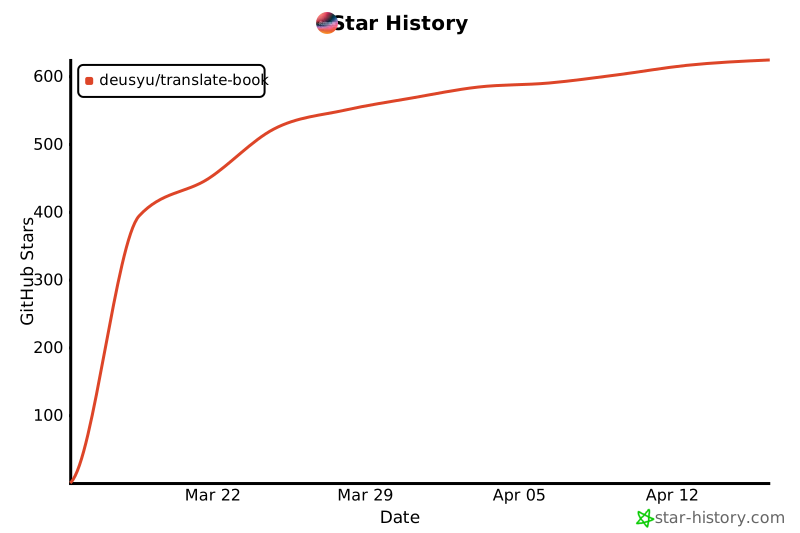](https://star-history.com/#deusyu/translate-book&Date)
## Sponsor
If this project saves you time, consider sponsoring to keep it maintained and improved.
[](https://github.com/sponsors/deusyu)
## License
[MIT](LICENSE)
Information
Repository
Language
Python
Created
2026/3/15
Updated
2026/8/6