

ks-mcp-server
The KubeSphere MCP Server is a Model Context Protocol(MCP) server that provides integration with KubeSphere APIs, enabling to get resources from KubeSphere. Divided into four tools modules: Workspace Management, Cluster Management, User and Roles, Extensions Center.
KubeSphere MCP Server
The KubeSphere MCP Server is a Model Context Protocol(MCP) server that provides integration with KubeSphere APIs, enabling to get resources from KubeSphere. Divided into four tools modules: Workspace Management, Cluster Management, User and Roles, Extensions Center.
Prerequisites
You must have a KubeSphere cluster. contains: Access Address, Username, Password.
Installation
Generate KSConfig
The format is similar to kubeconfig. This configuration contains HTTP connector information. The default context for KubeSphere is kubesphere, which can be modified via the environment variable KUBESPHERE_CONTEXT.
apiVersion: v1
clusters:
- cluster:
    certificate-authority-data: <CA file>
    server: <Server Address>
  name: kubesphere
contexts:
- context:
    cluster: kubesphere
    user: admin
  name: kubesphere
current-context: kubesphere
kind: Config
preferences: {}
users:
- name: admin
  user:
    username: <KubeSphere Username>
    password: <KubeSphere Password>
<CA file>: Optional. Fill in the CA certificate in base64-encoded format when KubeSphere is accessed via HTTPS.
<Server Address>: Required Must be an HTTPS address. (If using HTTP, enter any HTTPS address here, then modify via the parameter --ks-apiserver http://xxx)
<KubeSphere Username>: Required The user for the KubeSphere cluster.
<KubeSphere Password>: Required The password for the KubeSphere cluster user.
Get ks-mcp-server binary
you can run command go build -o ks-mcp-server cmd/main.go or download from (github releases)[https://github.com/kubesphere/ks-mcp-server/releases]
and then move it to $PATH.
Configuration MCP Server in AI Agent
Claude Desktop
- According to Claude Desktop should change the MCP Configuration. like:
{
  "mcpServers": {
    "KubeSphere": {
      "args": [
        "stdio",
        "--ksconfig", "<ksconfig file absolute path>",
        "--ks-apiserver", "<KubeSphere Address>"
      ],
      "command": "ks-mcp-server"
    }
  }
}
<ksconfig file absolute path>: Required The absolute path of the ksconfig file.
<KubeSphere Address>: Optional (but required for HTTP access) The access address of the KubeSphere cluster, supporting either the ks-console or ks-apiserver service address (e.g., http://172.10.0.1:30880).
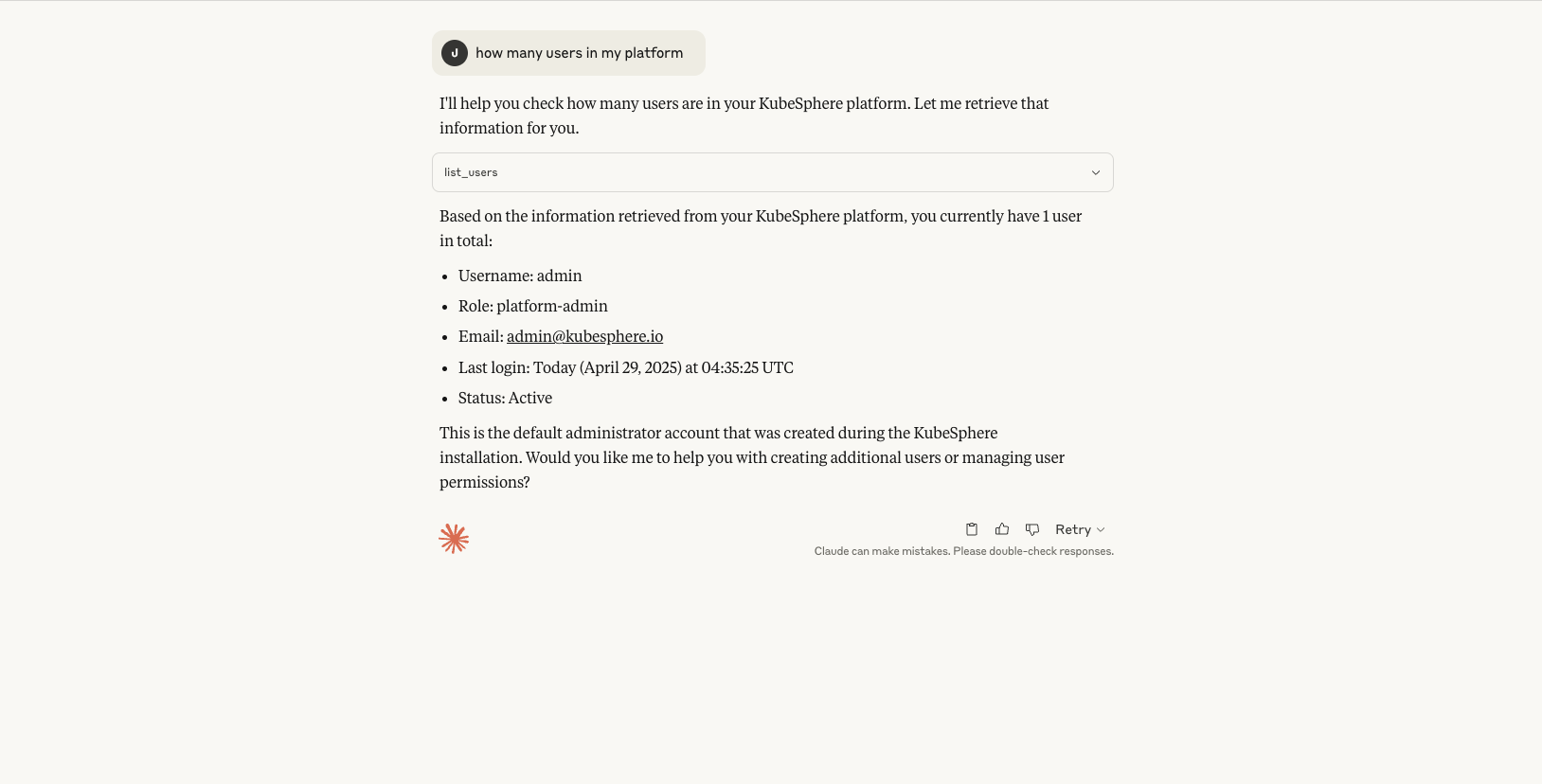
- chat with mcp server
Cursor
- According to Curosr should change the MCP Configuration. like:
{
  "mcpServers": {
    "KubeSphere": {
      "args": [
        "stdio",
        "--ksconfig", "<ksconfig file absolute path>",
        "--ks-apiserver", "<KubeSphere Address>"
      ],
      "command": "ks-mcp-server"
    }
  }
}
<ksconfig file absolute path>: Required The absolute path of the ksconfig file.
<KubeSphere Address>: Optional (but required for HTTP access) The access address of the KubeSphere cluster, supporting either the ks-console or ks-apiserver service address (e.g., http://172.10.0.1:30880).
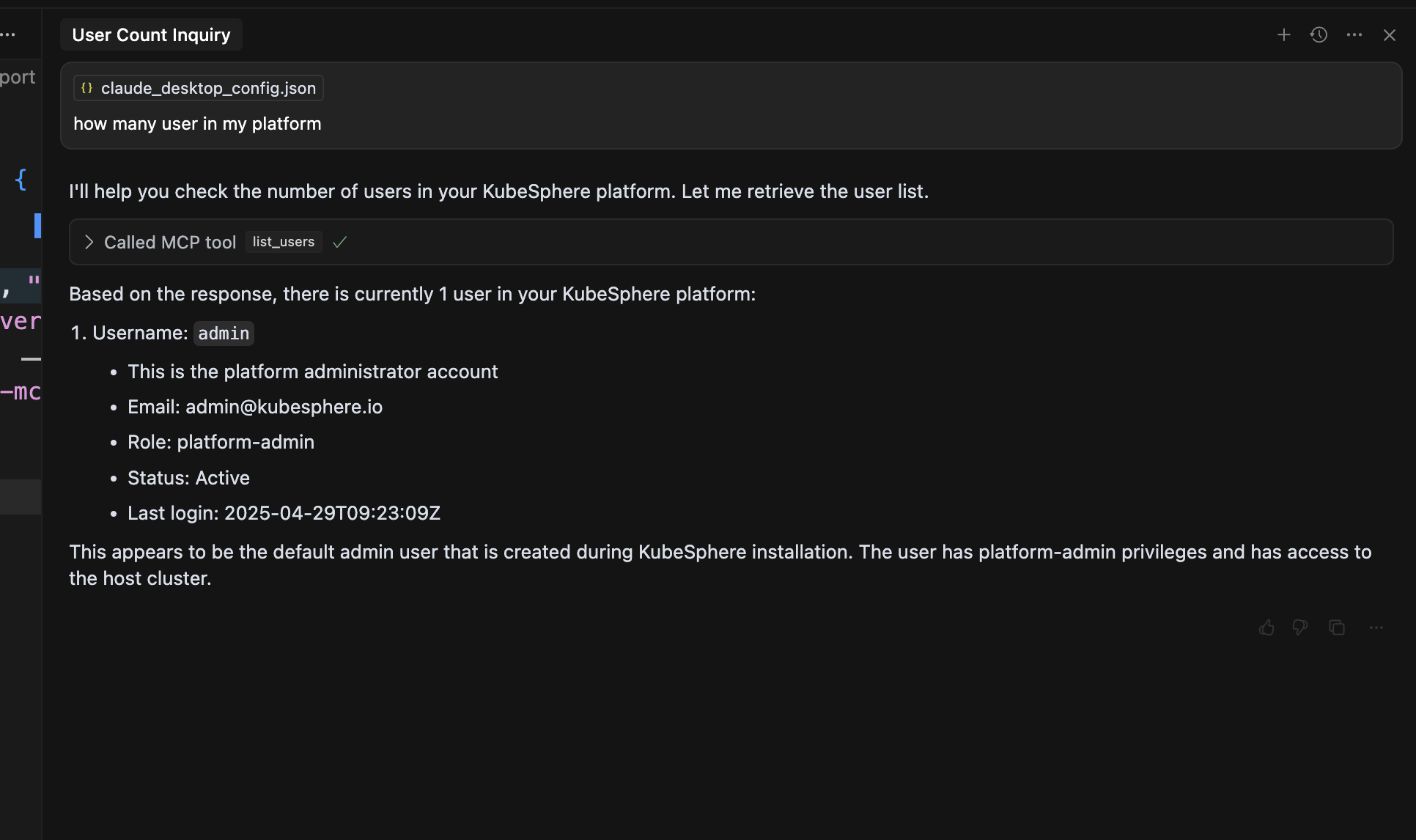
- chat with mcp server

Recommend MCP Servers 💡

mcp-azure-devops
An MCP server that enables AI assistants to interact with Azure DevOps services, providing functionalities for work item, project, and team management.


kokoro-tts-mcp
Kokoro Text to Speech (TTS) MCP Server that generates .mp3 files with option to upload to S3.

Defang MCP Server
Defang is an AI-enabled cloud deployment platform that simplifies deploying applications to various cloud providers (AWS, GCP, DigitalOcean) with a single command, handling infrastructure complexities like security, scalability, and cost-efficiency.

@aiondadotcom/mcp-salesforce
A Model Context Protocol (MCP) server for seamless Salesforce integration, offering OAuth authentication and universal CRUD operations on any Salesforce object for AI assistants like Claude.


buryhuang/mcp-server-aws-resources
A Python-based MCP server enabling Claude to query and manage AWS resources via boto3, with sandboxing and containerization for secure execution.

@mingdaocloud/hap-mcp
HAP MCP Server by MingdaoCloud enabling seamless AI integration with HAP application APIs via stdio and SSE transports